Choose the Right Bird Dog Breed
HuntWithDog · Dec 02, 2025
A clear, field-tested guide to choosing the right bird dog breed for upland hunting, with practical tips for beginners learning quail, pheasant, and partridge work.
Tabla de contenidos
- 1.⭐ TL;DR (Fast Summary)
- 2.Context: Why Breed Choice Matters
- 3.Prerequisites Before Choosing a Breed
- 4.Step 1 — Evaluate Your Terrain
- 4.1Small fields, brush, or dense cover
- 4.2Open prairie or large rolling land
- 5.Step 2 — Match the Dog to Your Hunting Pace
- 6.Step 3 — Choose Temperament That Fits You
- 6.1Sensitive, handler-focused breeds
- 6.2High-drive, independent athletes
- 7.Step 4 — Match Breed to the Birds You Hunt Most
- 8.Step 5 — Consider Versatility (Upland + Waterfowl)
- 9.Step 6 — Think About Home Life
- 10.Step 7 — Be Honest About Training Time
- 10.1Mistake 1 — Choosing a dog that runs too big
- 10.2Mistake 2 — Expecting one dog to fit every style
- 10.3Mistake 3 — Picking a high-drive Pointer without time to train
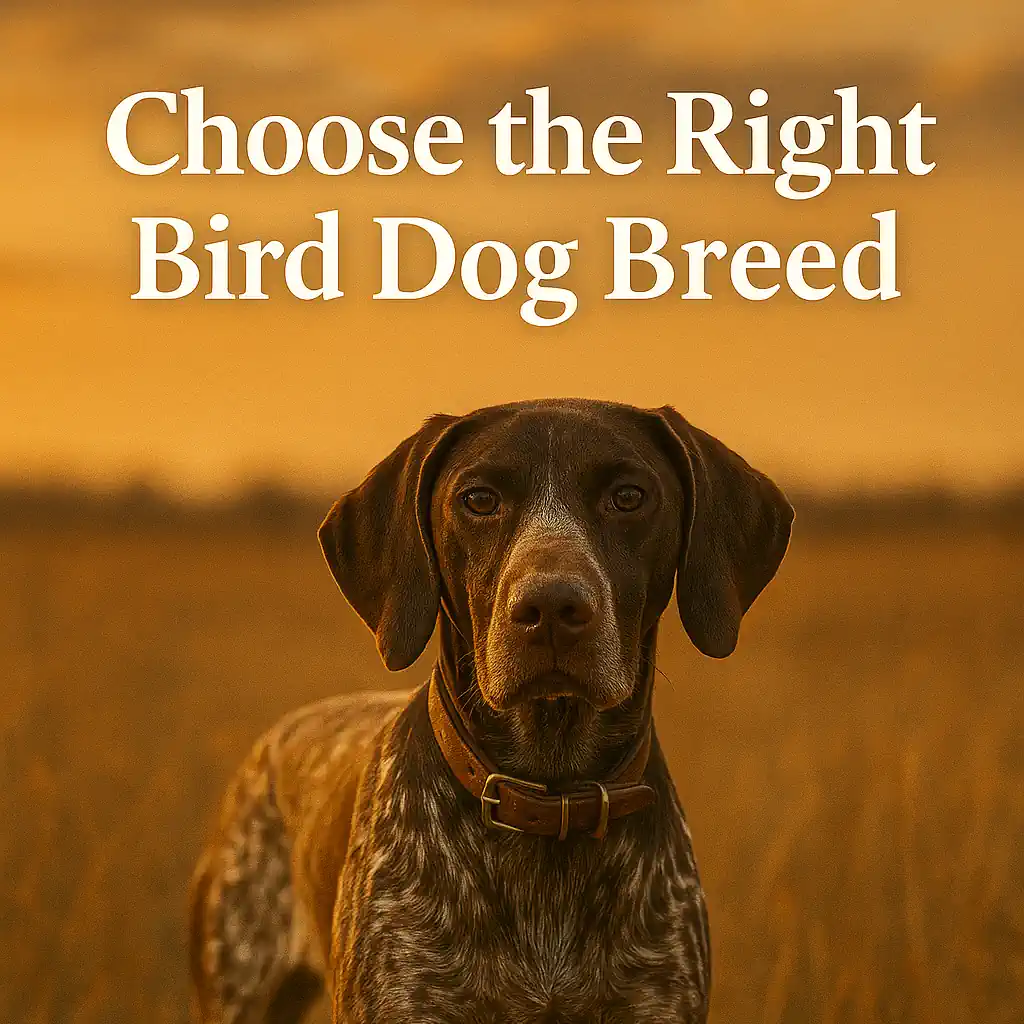
Choose the Right Bird Dog Breed
Choosing a bird dog is one of the most important decisions an upland hunter makes.
A dog matched to your terrain, pace, and personality becomes a long-term partner—not just a tool in the field.
This guide breaks down the major pointing breeds for quail, pheasant, and partridge, with clear, field-tested advice for beginners and intermediate hunters.
⭐ TL;DR (Fast Summary)
- Choose a breed that fits your hunting style, not someone else’s.
- Best for beginners: Brittanys & GSPs.
- Best for open country: English Pointers.
- Most versatile: GSP.
- Most relaxed at home: English Setters.
- Consider range, temperament, climate, and how much time you have for training.
Context: Why Breed Choice Matters
Not all upland terrain is the same, and neither are the dogs working it.
Some dogs naturally keep a tight, cooperative pattern. Others push 300+ yards with confidence. Understanding these differences prevents frustration and helps both handler and dog succeed earlier.
⭐ Key Point: A dog that matches your hunting terrain reduces corrections, increases productivity, and makes your early seasons far more enjoyable.
Prerequisites Before Choosing a Breed
Think honestly about:
- Your terrain: brush, mixed fields, prairie, woods.
- Your pace: slow and methodical, or fast and wide-ranging.
- Your time: daily micro-sessions or occasional weekend training.
- Your goals: only upland, or upland + waterfowl.
- Your household: calm indoor dog vs. high-drive athlete.
💡 Tip: Your lifestyle at home is just as important as your hunting goals.
Step-by-Step Guide to Choosing the Right Breed
Step 1 — Evaluate Your Terrain
Small fields, brush, or dense cover
Choose a dog that stays close and works naturally within sight:
- Brittany
- GSP
- Some Setters
Open prairie or large rolling land
Choose a dog bred for speed and distance:
- English Pointer
- Big-running Setters
⭐ Key Point: Range is mainly genetics—not training.
Step 2 — Match the Dog to Your Hunting Pace
-
Prefer calm, controlled walking?
→ Brittany or Setter. -
Prefer covering ground fast?
→ Pointer or big-ranging Setter.
💡 Tip: Many beginners overestimate the range they want.
Step 3 — Choose Temperament That Fits You
Sensitive, handler-focused breeds
- Brittany
- Setter
High-drive, independent athletes
- Pointer
- Some GSP lines
⚠️ Warning:
If you dislike managing a dog that runs far, avoid high-drive Pointer lines.
Step 4 — Match Breed to the Birds You Hunt Most
| Bird | Best Breeds | Why | |------|-------------|-----| | Quail | Pointer, Setter | Wide pattern, excellent noses | | Partridge | Brittany, GSP | Medium range, good tracking | | Pheasant | GSP, Setter | Running birds require tracking + retrieving |
Step 5 — Consider Versatility (Upland + Waterfowl)
If you hunt both upland and some ducks, GSP is the best multi-purpose choice.
Setters and Brittanys can retrieve waterfowl but aren’t built for sustained cold-water work.
Step 6 — Think About Home Life
- Calmest indoors: Setter
- Great balance: Brittany
- High energy: GSP
- High drive / more intense: Pointer
⭐ Key Point: Home behavior matters more than many new hunters expect.
Step 7 — Be Honest About Training Time
- Low to moderate training time: Brittany, GSP
- Higher skill/experience required: Pointer, some Setter lines
💡 Tip: Choose the dog you can train consistently, not the one you hope you can handle.
Field Safety Checklist
- Keep dogs hydrated in warm weather.
- Use GPS or a beeper in dense cover.
- Check paws often (burs, cactus, cuts).
- Avoid overheating—especially young dogs.
- Carry a canine first-aid kit.
- Watch for barbed wire.
- Maintain tick and parasite prevention.
Common Mistakes & How to Avoid Them
Mistake 1 — Choosing a dog that runs too big
Fix: Start with Brittany or GSP until you learn dog handling.
Mistake 2 — Expecting one dog to fit every style
Fix: Match your breed to your land and birds.
Mistake 3 — Picking a high-drive Pointer without time to train
Fix: Be realistic about your experience and schedule.
Practical Examples
- New hunter with 80 acres mixed cover: Brittany or GSP.
- Hunter in wide-open prairie: English Pointer.
- Family with young kids: English Setter.
- Hunter chasing pheasant in heavy grass: GSP (tracking + retrieving).
Quick Comparisons (Easy Reference)
| Breed | Range | Temperament | Best For | |-------|--------|-------------|-----------| | Brittany | Close–medium | Cooperative | Beginners, mixed cover | | GSP | Medium | Versatile, energetic | Upland + some ducks | | Pointer | Medium–far | High drive | Open country, quail | | Setter | Medium–far | Calm, steady | All-day hunts, families |
Editorial Insight
Most hunters think they want a big-running dog—until they hunt with one.
A closer-working breed is usually more productive and more enjoyable for new hunters.
Next Step
Check out our guide:
The Four Stages of Training a Bird Dog
Conclusion
The “best” bird dog doesn’t exist—only the right breed for you.
Match your dog to your terrain, pace, and goals, and you’ll enjoy a decade of successful hunts and unforgettable days in the field.
Frequently Asked Questions
What is the best bird dog for beginners?▼
Brittanys and GSPs are often the easiest for beginners due to their cooperative nature, manageable range, and strong natural instincts.
How far should a pointing dog range while hunting?▼
Most beginners prefer 40–120 yards. Brittanys and GSPs stay in that pocket naturally, while English Pointers and Setters tend to run farther.
Do certain breeds work better for quail?▼
Pointers and Setters excel on quail thanks to their speed, nose, and wide pattern. Brittanys and GSPs also perform well in mixed or tighter cover.
What bird dog breed is best for pheasant?▼
GSPs and Setters handle pheasant best because they combine pointing ability with strong retrieving instincts—useful with running birds.
How important is the dog's nose quality?▼
A strong nose is critical for locating scent cones and holding birds properly. All major pointing breeds have good noses, but Pointers and Setters often excel in open terrain.
Can one dog work both upland and waterfowl?▼
Yes. GSPs are the most versatile choice for mixed upland and light waterfowl work.
Are Brittanys good for first-time hunters?▼
Yes. They stay close, learn quickly, and offer a forgiving temperament ideal for new handlers.
Do I need a big property to train a Pointer?▼
Not necessarily, but Pointers thrive in open land. If you hunt small parcels or dense cover, a moderate-range breed may fit better.
What breed handles hot weather best?▼
English Pointers are known for endurance in heat, especially in southern quail country.
Which bird dog is the calmest at home?▼
Setters tend to be the calmest indoors, followed by Brittanys. Pointers and GSPs usually need more structured exercise.